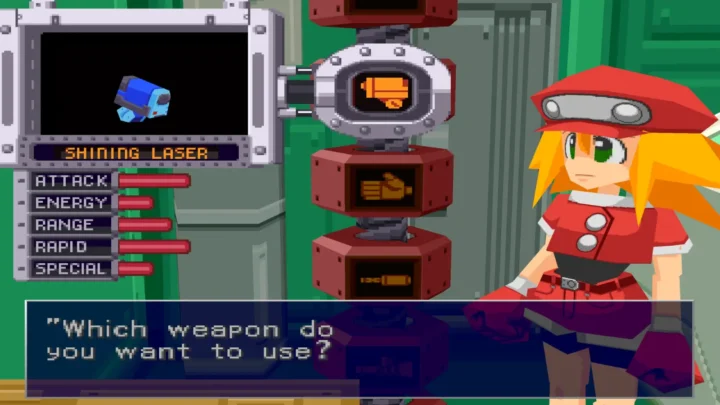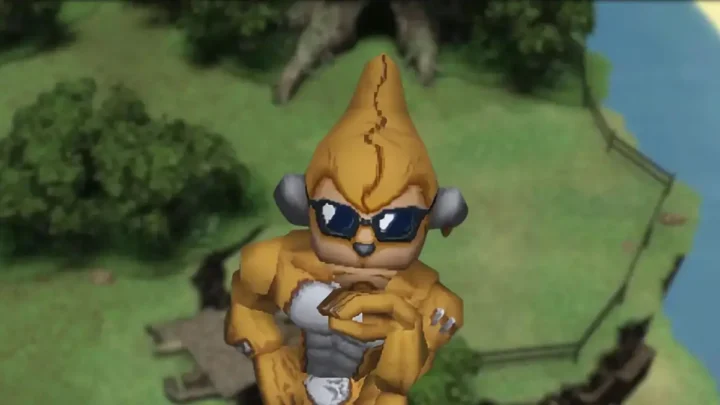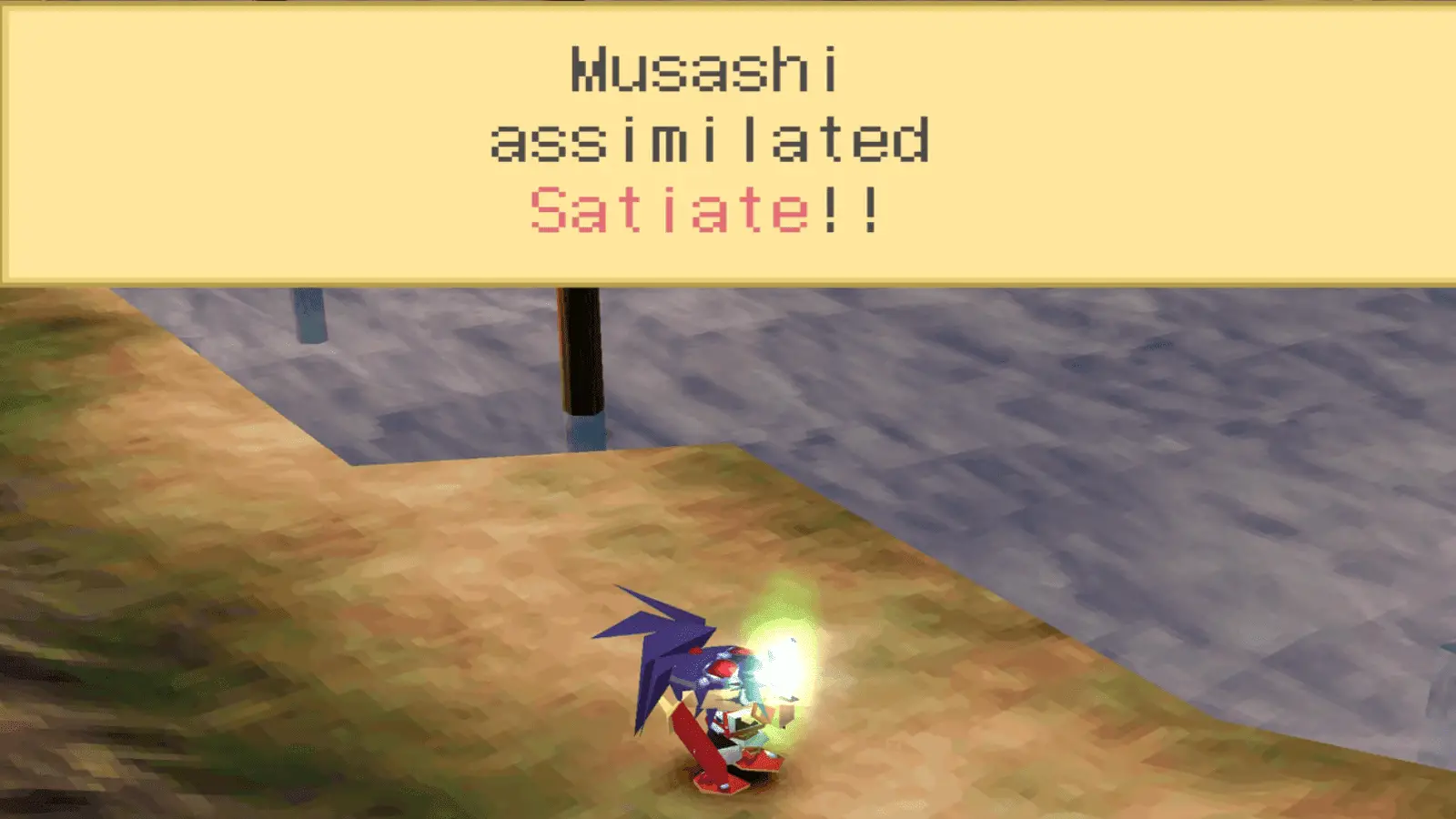
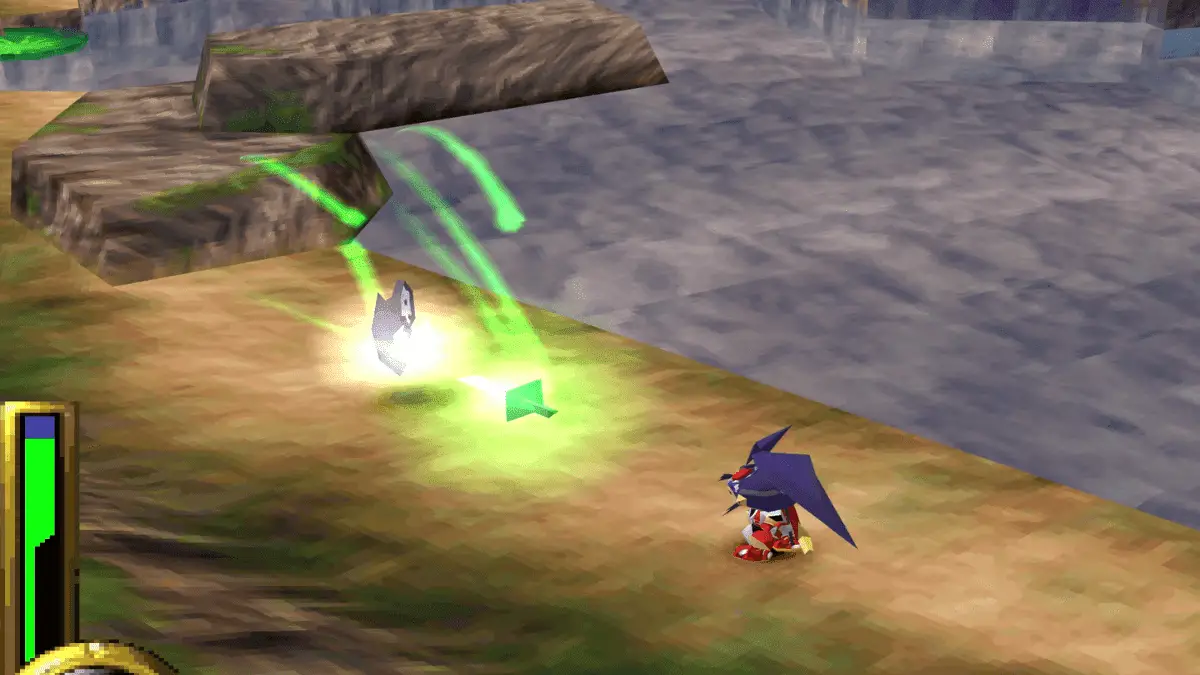
Brave Fencer Musashi teaches you its best idea almost immediately. You reach a river with no bridge, spot a Blue Thirstquencher Soldier nearby, charge Fusion, throw the sword into him, mash Square until the gauge fills, and steal Gunshot. A few telekinetic bullets later, three logs fall across the water and your enemy has become the solution to the room.
That is the Assimilate system in Brave Fencer Musashi, and twenty-eight years later I still think it is one of the smartest ideas Square put into a PS1 action RPG. The interesting part is not simply that Musashi can copy enemy abilities. It is that the game keeps asking you to look at enemies as potential tools instead of disposable obstacles.
Quick answer: Assimilation lets Musashi use Fusion to absorb one enemy ability at a time. Hold R1 to charge, press Square to throw Fusion into an enemy, then rapidly press Square until the gauge fills. Most stored abilities are activated with Circle and consume Bincho Power. Some effects trigger immediately instead. If you assimilate a new ability, it replaces the one you were carrying.
Last checked: August 22, 2026. I rechecked the Assimilation controls against the original North American manual, along with ability names and BP costs, the game’s tiredness system, Fusion leveling, and the specific puzzle uses discussed below.
How the Assimilate System Works in Brave Fencer Musashi
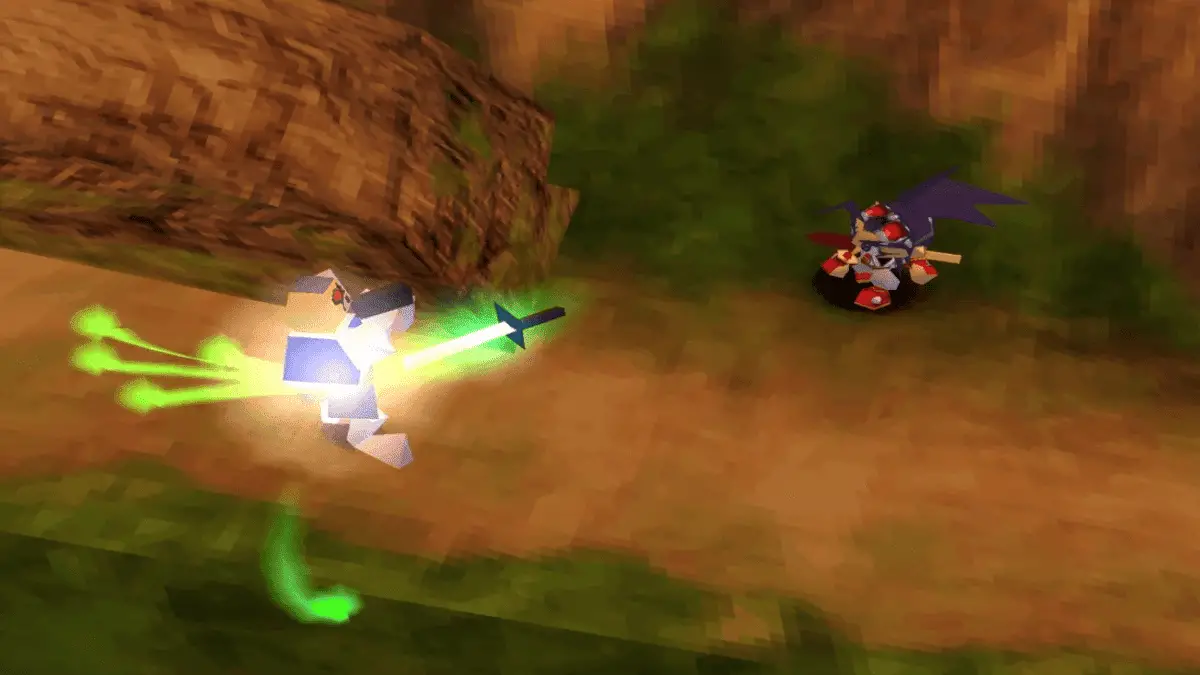
Musashi eventually carries two swords. Fusion is the lighter blade used for quick attacks and Assimilation. Lumina is the heavier Sword of Luminescence, whose powers are tied to the five Scrolls.
The original Brave Fencer Musashi manual lays Assimilation out clearly:
- Hold R1 until the charge gauge fills.
- Press Square to throw Fusion into the enemy.
- Rapidly press Square while Fusion is stuck in the target.
- Fill the gauge before the time limit expires and you absorb the ability.
- Use stored activated abilities with Circle.
If you fail to fill the gauge in time, you do not get the ability. Fusion returns and Musashi steals a small amount of BP instead. The manual also divides Assimilation powers into two broad types: abilities you trigger manually and effects that begin automatically as soon as they are absorbed.
The important limitation is that Assimilation is not a permanent spellbook. You carry one stolen ability, and grabbing another replaces it. Dying while holding one also makes you lose it. That single-slot rule is what gives the system teeth. Finding something useful always comes with the question of whether you want to throw away what you already have.
Bincho Power and Tiredness Are Two Different Pressures
The old version of this article blurred these systems together, so this is worth separating.
Bincho Power, or BP, is the resource used by Assimilation abilities and other special powers. BP also gradually decreases as game time passes. Different stolen abilities have different costs, from tiny 2-BP effects to the 50-BP Grenade.
Tiredness is separate. It rises as Musashi stays awake. At high tiredness he moves and attacks more slowly, and at around 70% or higher he can begin nodding off in the field. I would not say the game applies a special “Assimilation becomes nearly impossible at 70%” rule. The broader problem is that an exhausted Musashi is slower and less pleasant to control.
This is where Grillin’ Village matters. The bakery sells BP-restoring food and runs on an actual schedule, while Hotelo’s Inn is open around the clock and can restore tiredness along with varying amounts of HP and BP. The game’s clock keeps these mechanics tied to the world instead of turning recovery into a menu you can summon from the ether.
That is one reason Grillin’ Village also made my list of the best PS1 hub worlds and cities. Its shops and routines are not decoration. They affect how you plan an outing.
Every New Enemy Might Be a Tool
Not every enemy in Brave Fencer Musashi can be assimilated, but enough of them can that seeing a new creature immediately feels different from finding another normal monster in most action RPGs.
The enemy itself is basically a locked item description. You do not know whether you found a weapon, a puzzle solution, a status effect, or a practical joke until you stick Fusion into it and find out.
| Enemy | Ability | BP | What It Does |
|---|---|---|---|
| Blue Thirstquencher Soldier | Gunshot | 1 per shot | Fires telekinetic bullets; introduced in the opening river puzzle |
| Lamp Bat | Firefly | 8 | Temporarily lights dark areas |
| Stomp Golem | Steel | 24 | Turns Musashi metallic so he can destroy special spikes |
| Magician | Shrink | 10 | Shrinks enemies so Musashi can stomp them |
| Bee Plant | Perfume | 2 | Temporarily reduces damage |
| NeedlAnt / Red Ant | Depress | 4 | Makes giant ants stop attacking Musashi |
| Vambee family | B.O. | 8 | Surrounds Musashi with a terrible smell that keeps bats away |
| Toad Stool | Toxin | 2 | Poisons Musashi, because sometimes the treasure chest contains garbage |
The original source called the Stomp Golem power “Stomp.” The actual Assimilated ability is Steel. Likewise, the Lamp Bat power is Firefly, not simply “Lamp.” Those details matter when someone goes from an essay like this to an actual guide and starts searching the game for the wrong ability name.
The Best Assimilate Abilities Are Puzzle Pieces
The combat abilities are fun, but the system becomes memorable when a creature is the missing verb in an environmental puzzle.
The opening Gunshot example is the cleanest tutorial. Lamp Bats provide Firefly for dark areas. Stomp Golems provide Steel for destroying metal spikes. Magicians give Shrink, which lets Musashi shrink enemies and stomp them flat. The King Maneater encounter is built around that idea: ordinary attacks do not solve the problem cleanly, while Shrink turns a huge obstacle into something Musashi can literally crush.
I lost my mind the first time I did that as a kid. The giant enemy suddenly becoming tiny and getting flattened was funny enough on its own, but the bigger realization was better: the solution had been walking around nearby with a health bar.
One correction from the old article, though: you absolutely can carry an Assimilated ability from one area into another as long as you do not overwrite it or die. The game frequently places the needed enemy near a puzzle, but it is not enforcing a hard “this ability can only exist in this room” rule.
The Weird Abilities Are Why I Remember the System
A traditional copy-ability system could have stopped at bullets, fire, jumping, and defense buffs.
Brave Fencer Musashi decided you should also absorb depression.
Depress comes from the NeedlAnt/Red Ant and makes giant ants leave Musashi alone. B.O. surrounds him with a cloud of putrid fumes that keeps bats from attacking. Toxin from a Toad Stool poisons you. Perfume makes you tougher. Satiate temporarily restores BP. Some abilities are clever. Some are situational. Some feel like Square was allowed to write one more joke and accidentally turned it into a mechanic.
That unpredictability is the reward. I used to assimilate enemies simply because I had never seen them before. A chest already tells you it contains something. A strange enemy in Musashi makes you wonder whether it is something.
That same willingness to try odd ideas is why I included Brave Fencer Musashi among my PS1 hidden gems worth playing.
It Is Almost the Opposite of a Final Fantasy Blue Mage
The easiest comparison is Square’s own Blue Mage idea, but Assimilation creates almost the opposite relationship with copied abilities.
A Blue Mage builds a library. The pleasure is accumulation. Every learned spell makes the permanent toolkit larger.
Musashi does not build a library. He steals one thing, uses it, then eventually throws it away for something else. The pleasure is adaptation. You are not asking, “What have I collected?” You are asking, “What is useful here?”
That keeps the enemy roster relevant. A weak creature can be more exciting than a stronger one if you have never tested its ability.
Fusion Gets Stronger Too, but Not the Way I Remembered
The old version of this article said successful extractions made Fusion stronger and that neglecting Fusion made later Assimilation slower or more dangerous. I could not substantiate that, and the original manual says something different.
Musashi has separate Body, Mind, Fusion, and Lumina growth categories. Fusion’s level increases when Musashi successfully attacks enemies with Fusion, raising the sword’s attack power. Lumina improves the same way through successful Lumina attacks.
That still rewards using both swords, but it is not a hidden “Assimilation proficiency” meter. The extraction minigame remains its own charge-and-mash mechanic.
Why the Assimilate System Still Feels Ahead of Its Time
Brave Fencer Musashi released in 1998, the same year 3D action-adventure games were exploding in different directions. The Legend of Zelda: Ocarina of Time built a lasting model around a growing inventory of permanent tools. Musashi went somewhere stranger: many of its tools were temporary, alive, and trying to kill you before you could borrow them.
I would not claim no other game ever did anything similar. Copy abilities existed long before Musashi, and games have continued borrowing enemy powers ever since. What feels distinctive is the combination of one-slot impermanence, enemy-specific puzzle utility, resource cost, and a world whose schedules can affect how easily you recover afterward.
Even the sequel, Musashi: Samurai Legend on PS2, moved toward a different action-game structure rather than simply rebuilding the same system. The original remains unusually committed to making the enemy roster part of the player’s toolbox.
As of August 2026, I still could not find a current modern-console or PC re-release of the original North American game from Square Enix. Japan received a PSOne Classics release years ago, but the original is still absent from the modern re-release wave that has rescued so many other PS1 oddities.
Brave Fencer Musashi Assimilate FAQ
How do you Assimilate abilities in Brave Fencer Musashi?
Hold R1 until the charge gauge fills, then press Square to throw Fusion into an enemy. Rapidly press Square again until the gauge fills a second time. If you succeed before Fusion returns, Musashi absorbs the enemy’s ability.
How many Assimilate abilities can Musashi hold?
One at a time. Assimilating another enemy replaces the current ability, and dying causes Musashi to lose the ability he was carrying.
What button uses Assimilated abilities?
Most stored abilities are activated with Circle. Some abilities take effect automatically as soon as Assimilation succeeds and last for a limited time.
What is BP in Brave Fencer Musashi?
BP means Bincho Power. Assimilated techniques and other special powers consume it, and BP also decreases as time passes. It is separate from the game’s Tiredness percentage.
Does Fusion level make Assimilation faster?
The original manual says Fusion level increases Fusion’s attack power when Musashi successfully lands attacks with the sword. I could not find reliable documentation saying Fusion level directly speeds up the Assimilation extraction gauge.
What ability do you get from the Stomp Golem?
The Stomp Golem gives Steel, not an ability named Stomp. Steel turns Musashi metallic and allows him to destroy special metal spikes.
The Enemy Was the Item Box
That is the idea I keep coming back to.
Brave Fencer Musashi could have filled Grillin’ Village with shops, put twenty permanent spells in a menu, and let the enemies exist purely as things to hit. Instead, it made you suspicious of every new creature in the best possible way.
A bat might be a flashlight. A giant golem might be a way through spikes. A magician might be the answer to a monster blocking the path. A disgusting Vambee might give Musashi body odor with legitimate tactical value.
That is why Assimilation stuck with me. It made curiosity useful.
Twenty-eight years later, I still want to see what happens when I throw Fusion into the weird thing standing in front of me.